2026 Shanghai International Textile Graduate Summer School Teaching Briefing
Issue3 July 5, 2026 E-mail: fzsqxx@dhu.edu.cn
2026organizing committee of Shanghai Textile Graduate InternationalSummer,
writtenby: YingHua Wei
OnJuly 5, the 2026 Shanghai International Summer School for TextileGraduate Students continued its series of high level academic lectures. Professor Frederic Heim from the University of Haute Alsace(France), Associate Professor Liu Li from Donghua University, and Professor RongHua Gong from the University of Manchester (UK) delivered insightful presentations on their respective researchfrontiers, offering the participants a wealth of academic insights.
Professor Heim focused his talk on textile based vascular grafts andstent grafts, systematically analysing the design difficultiesand performance limitations of vascular stents. He pointed out that an ideal vascular graft must possess low thrombogenicity and goodbiocompatibility to achieve effective matching with native bloodvessels. Regarding structural selection, woven fabrics offer better dimensional stability, while knitted fabrics exhibit greater deformability but suffer from relatively inferior durability. Toimprove material performance, Professor Heim introduced strategies such as silver modification, blending with elastic yarns, and coatingtreatments, which can effectively enhance antithrombotic propertiesand abrasion resistance. Looking forward, he proposed two major development directions: one is the combination of woven and nonwoven structures, and the other is the direct construction of biological blood vessels through cell culture. During the presentation,Professor Heim also displayed physical samples of vascular graftstructures for the participants to observe up close, sparking livelyinteraction.
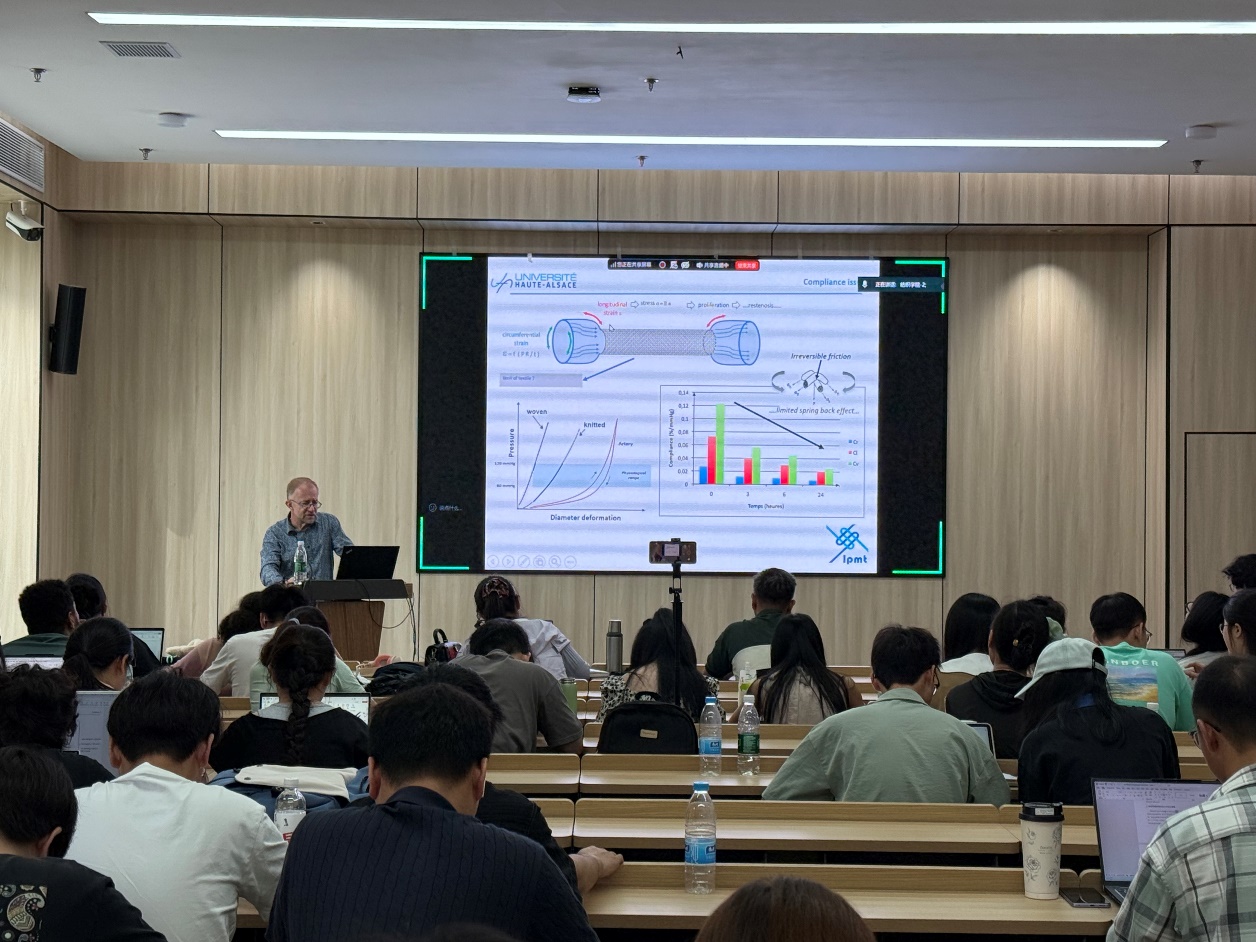
(ProfessorFrederic Heim)
Underthe title “Interesting Nonwovens,” Associate Professor Liu Lisystematically introduced the basic concepts and manufacturing processes of nonwoven materials, with an emphasis on the fundamental differences between nonwovens and traditional woven fabrics. While conventional textiles require a multi step process from fibresto yarns to fabrics, nonwovens skip the spinning stage entirely anddirectly form a fabric from fibres. He elaborated on the two coresteps in nonwoven production – web formation and bonding – whichrepresent a transformation from a three dimensional fibreassembly to a two dimensional planar material. Web formation methods mainly include wet laid and dry laid techniques(carding, air laid, and dry laid papermaking), while bonding methods encompass needle punching, hydroentangling(spunlace), thermal bonding, and chemical bonding. In addition, Professor Liu illustrated the broad application prospects of nonwovens in fields such as medical care, environmental protection,and filtration through numerous practical examples.
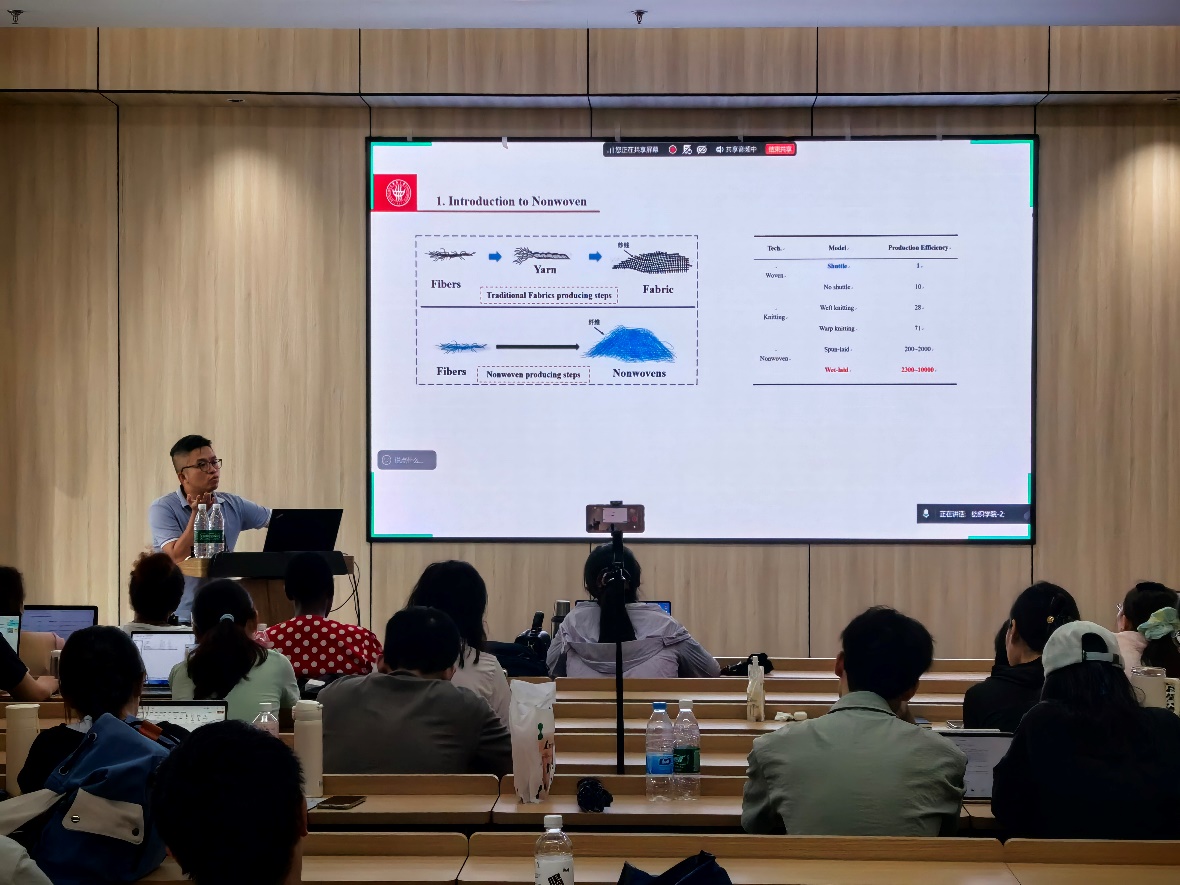
(AssociateProfessor Li Liu)
Professor Gong delivered a systematic lecture on the methodology of textile performance evaluation, focusing particularly on the validity and reliability of assessment. He started with the fundamentals of sampling, clarifying the concepts of population and sample, and then delved into three key representativeness pitfalls that must beavoided in evaluation – avoiding bias, clear definition, andconsistent handling. Subsequently, he introduced four common sampling methods: random sampling, systematic sampling, stratified sampling,and cluster sampling, illustrating their respective applications with examples. In the data interpretation section, Professor Gong furtherexplained critical statistical concepts such as accuracy andprecision, random error and systematic error, and significance level, helping participants develop a sound awareness of error control. These methods laid a solid methodological foundation for the participants to conduct future fabric property tests, including pilling, bending, and drapeability.
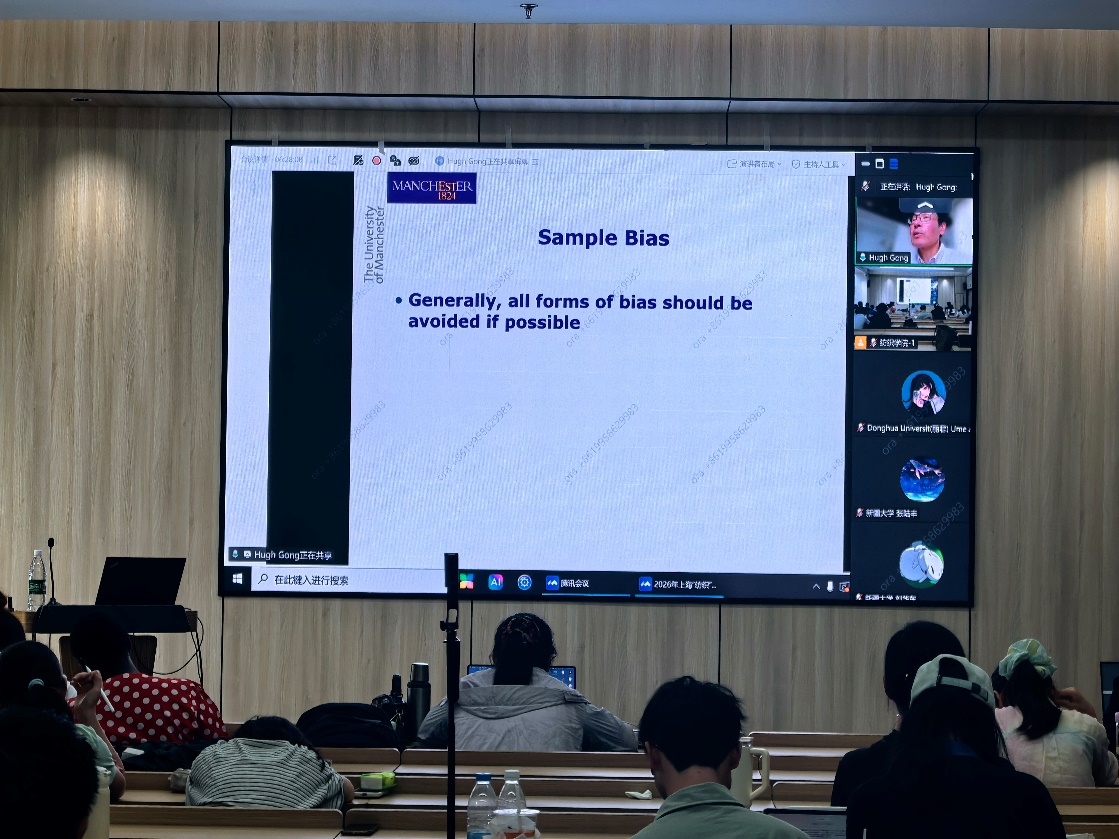
(Professor RongHua Gong)
Thethree presentations were rich in content and diverse in perspectives,encompassing both cutting edge technological explorations andrigorous methodological training, greatly broadening the academic horizons of the participants. The summer school will continue toprovide high level academic exchanges to support young scholarsin their steady progress along the path of textile research.

