2026 Shanghai International Textile Graduate Summer School Teaching Briefing
Issue2 July 4, 2026 E-mail: fzsqxx@dhu.edu.cn
2026organizing committee of Shanghai Textile Graduate InternationalSummer,
writtenby: YingHua Wei
OnJuly 4, Professor Frederic Heim from the University of Haute-Alsace(France), Professor YingJiao Xu from North Carolina State University(USA), and Professor RongHua Gong from the University of Manchester(UK) delivered excellent academic presentations.
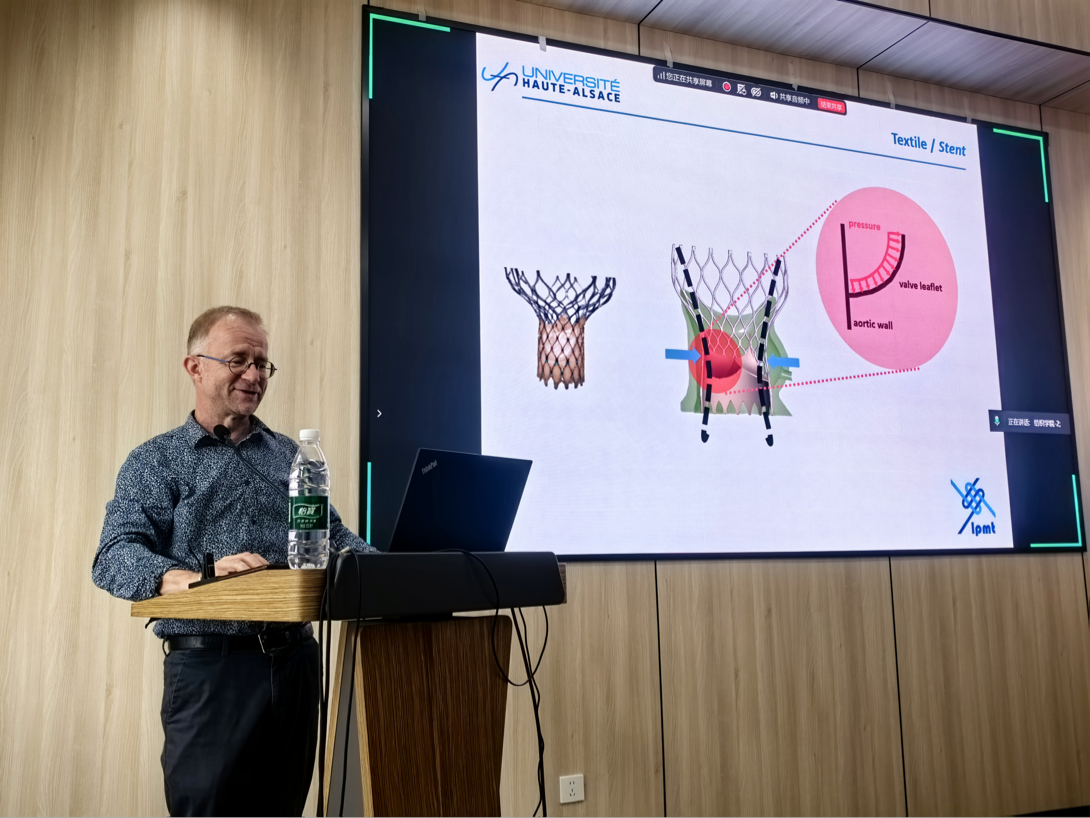
(Professor Frederic Heim)
Professor Frederic Heim focuses on cutting-edge textile applications in thebiomedical field, systematically addressing the specific requirements and technical challenges encountered in three typical scenarios:heart valve loading, surgical sutures, and vascular grafts. He placed particular emphasis on surgical sutures. Professor Heim pointed outthat suture degradation can be achieved through either hydrolysis orenzymatic pathways. Traditional monofilament sutures have a smoothsurface that resists bacterial adhesion, but they are difficult totie knots with. In contrast, multifilament sutures are flexible andeasy to knot, yet they tend to become breeding grounds for bacteria.To address infection issues arising from this, Professor Heimproposed an innovative barbed suture design that eliminates the needfor knotting during the suturing process while simultaneously reducing the risk of bacterial proliferation. Furthermore, heidentified clear future optimization directions: developing novelsutures that combine PET, elastic materials, and hybrid braided structures to mitigate the trade offs between mechanical strength and antimicrobial performance, thereby enhancing the overallclinical performance of sutures.

(Professor Yingjiao Xu)
Professor YingJiao Xu provided a systematic explanation of the definition andprocess of market research. She pointed out that primary data referto original information collected specifically for a given research problem, which can be obtained through methods such as interviews, questionnaires, and field observation. Secondary data, in contrast,are existing data that have been collected and compiled by others. Building on this, Professor Xu further distinguished between internaland external sources of secondary data. Regarding research methods,she focused on the relationship between qualitative and quantitative research: qualitative research aims to explore the essence of aproblem and is characterized by unstructured, small sample approaches, primarily using focus groups and in depthinterviews; quantitative research, by comparison, relies onquantified indicators and statistical analysis, featuring structured,large sample designs, with common methods including surveys,observation, and experiments. Overall, the two approaches complementeach other and together constitute the methodological framework ofmarket research.
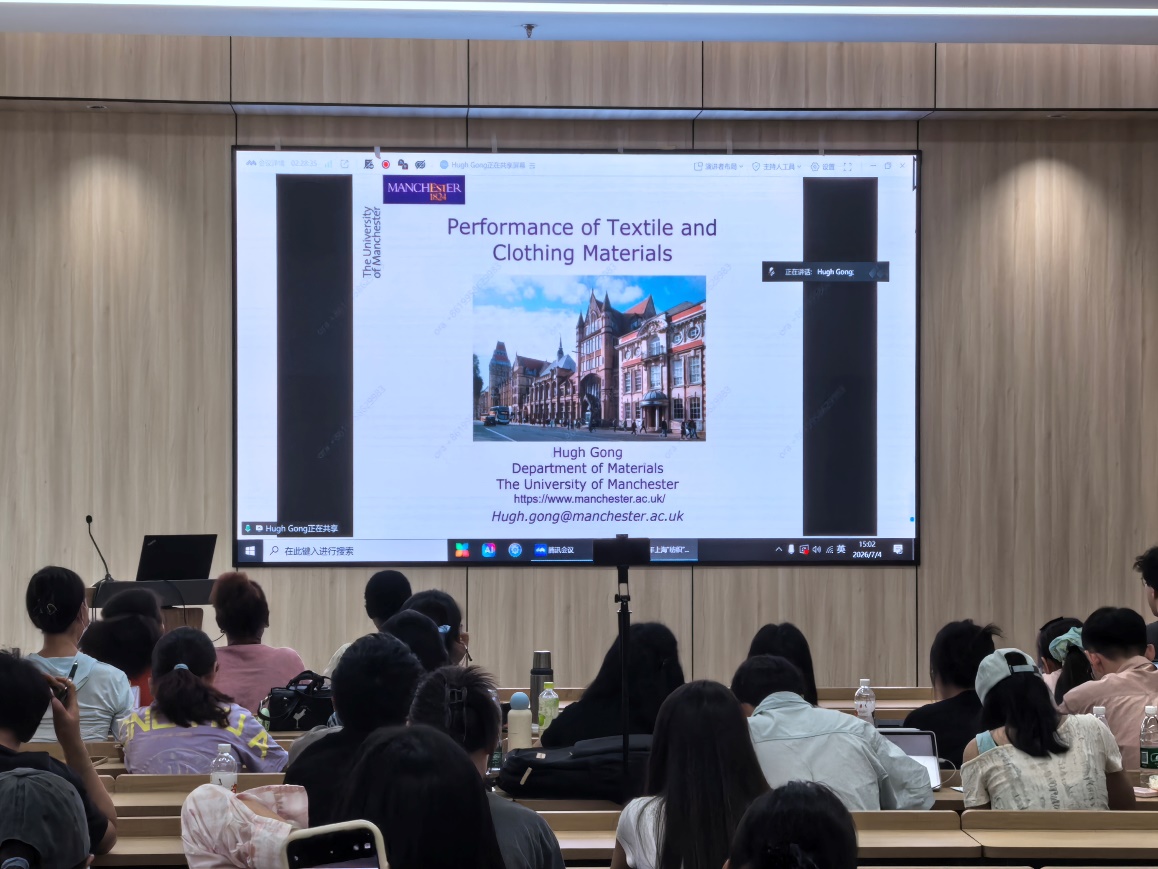
(Professor RongHua Gong)
Professor RongHua Gong delivered a systematic exposition on the performance evaluation of textile and apparel materials, establishing acomprehensive assessment framework for material properties. Hepointed out that textile materials are complex assemblies composed of polymers, fibers, yarns, and fabrics, exhibiting nonlinear mechanical behavior, deformability, and anisotropic characteristics. When evaluating such materials, it is necessary to take into accountmultiple dimensions, including mechanical properties, dimensional stability, comfort and safety in wear, as well as sustainability.Through standardized testing and evaluation, effective quality control can be achieved to ensure product compliance and safety. Inactual fabric selection, factors such as mechanical performance and environmental friendliness must be balanced; notably, theeco degrad ability of fabrics should be considered from the very initial stage of material design. In the final evaluation phase, astrict four step procedure should be followed—namely, adheringto standards, controlling test conditions, implementing scientific sampling, and employing statistical analysis—to guarantee the objectivity and reliability of the assessment results.

