2026Shanghai International Textile Graduate Summer School TeachingBriefing
Issue5 July 7, 2026 E-mail: fzsqxx@dhu.edu.cn
2026organizing committee of Shanghai Textile Graduate InternationalSummer,
writtenby: Enqi Wang
OnJuly 7, Associate Professor Lu Chunhong from Donghua University,Professor Xuyuan Tao from the French National Higher School ofTextile Engineering (ENSAIT), and Professor Roohollah from AmirkabirUniversity of Technology (Iran) delivered outstanding presentations.
Associate Professor Lu Chunhong systematically reviewed the characteristics ofmainstream spinning processes, including melt spinning and solutionspinning, with a focus on the performance advantages and applicationscenarios of three high-performance fibers: carbon fiber, aramid, andultra high molecular weight polyethylene (UHMWPE). She thenelaborated on her team’s significant breakthroughs in bio basedmaterials. To address the growing depletion of petroleum basedfeedstocks, they innovatively utilized lignin—a papermakingwaste—as a reinforcing phase and prepared PVA/lignin compositefibers via dry jet wet spinning. At a lignin content of 5%, thefiber crystallinity reached an optimum, and the mechanical propertieswere comparable to those of carbon nanotube reinforcedfibers, while production costs were substantially reduced. Thepresentation also revisited key technical aspects such as spinningprocess parameter control and filler dispersion mechanisms, offeringnew insights for the development of sustainable high performancefibers.
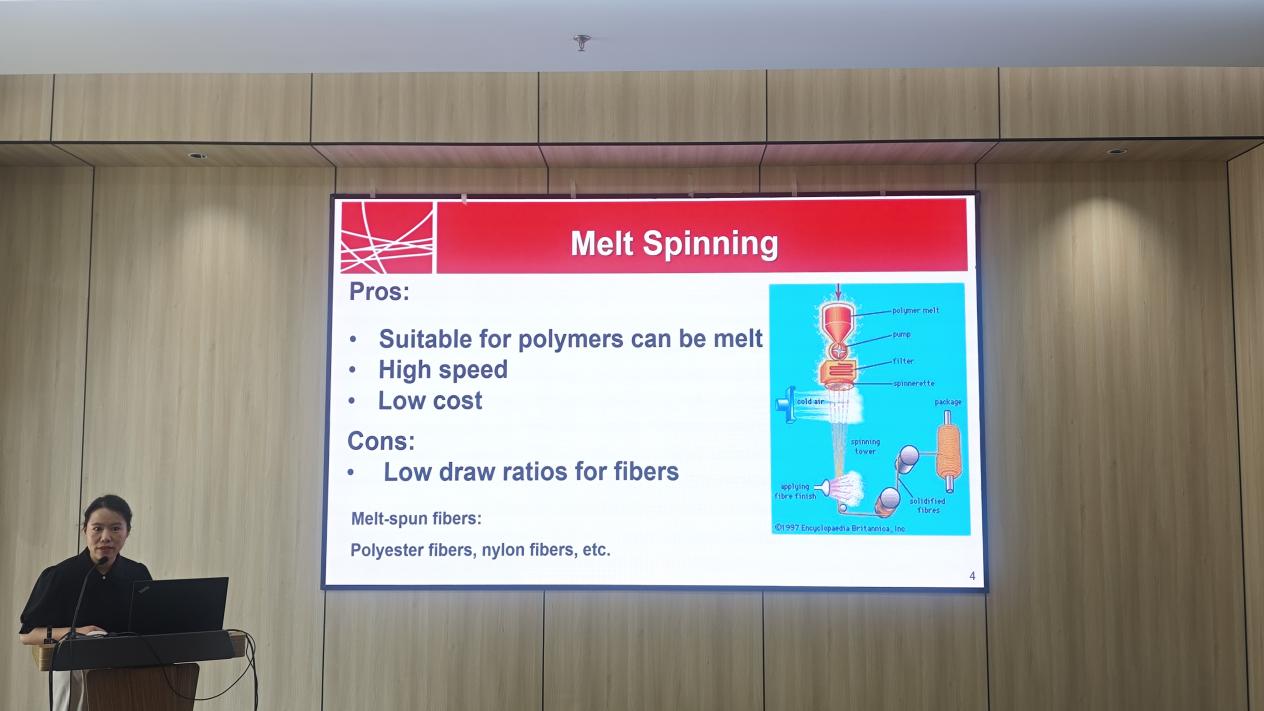
(Assoc.Prof. Chunhong Lu)
Professor Roohollah discussed the overarching trend of the textile disciplineevolving from traditional craftsmanship toward high performanceand intelligent functionalities, emphasizing the urgency ofinterdisciplinary integration and curriculum reform. The core of histalk focused on textile based energy harvesting devices. Hesystematically explained the principles of converting humanbiomechanical energy into electrical energy via piezoelectric andtriboelectric effects, introduced composite fabrication techniquesincluding nanoparticle dispersion and layer by layerstacking, and presented innovative design strategies—such as“spring like fibers” and “wrinkle structures”—toenhance stretchability and washability. He also candidly analyzedcurrent technical bottlenecks, including low output power, materialcracking, and the trade off between electrical conductivity andflexibility. He previewed future in depth discussions on textileapplications in biomedical fields, providing forward lookingguidance for self powered wearable devices.
(Professor Roohollah)
Professor Xuyuan Tao concentrated on electronic integration andcommercialization of smart textiles. He systematically reviewed fourinterconnection technologies—snap fasteners, flexible PCBs,conductive adhesives, and embroidery placement—and showcasedself developed achievements including fully flexible PCBs, ACFhot press conductive bonding, and electrochromic displays. Heunveiled prototype devices such as a multi interface fabriccircuit integrating 16 LEDs, a smart shirt for firefighters’physiological monitoring, and dry textile electrodes. Combined withAI models, these achieved fatigue classification into four levels andlong COVID risk screening with an accuracy of 97%. Addressingthe core barrier to commercialization, he detailed solutions towashability challenges through TPU encapsulation, plasmamodification, and mechanical stress modeling, offering a full chaintechnical pathway for moving smart textiles from the laboratory tothe mass market.
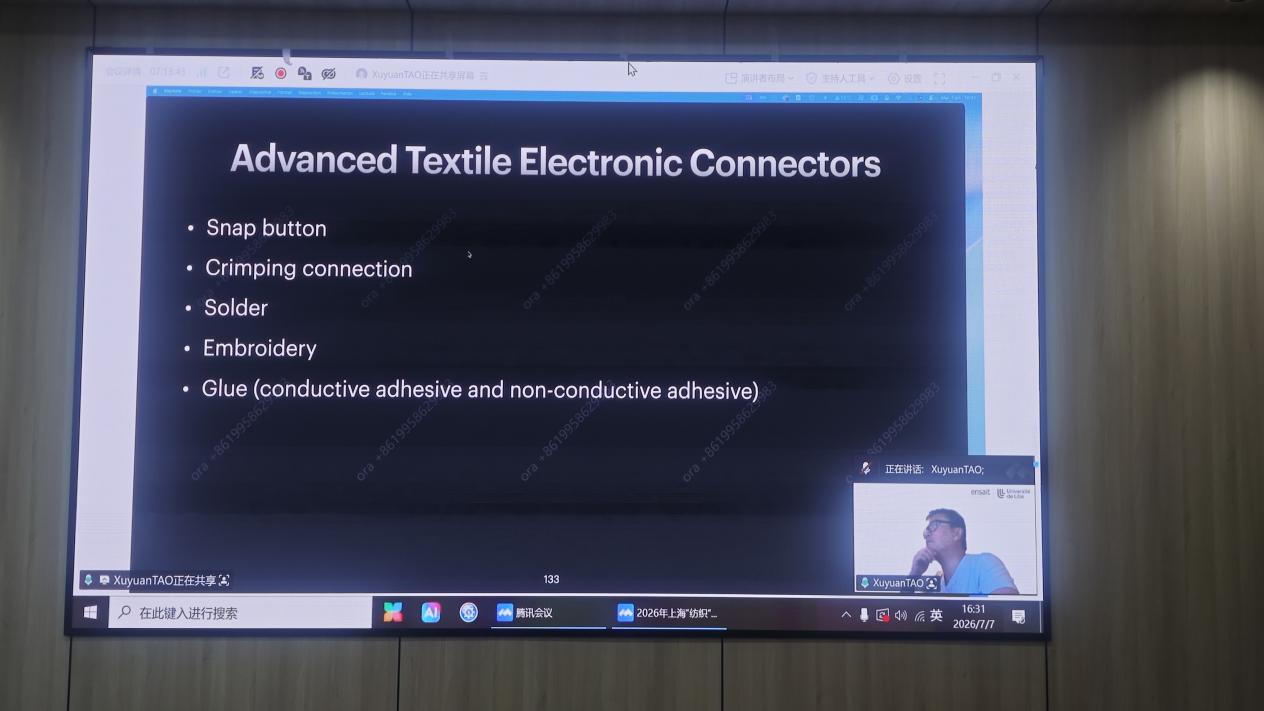
(Professor Xuyuan Tao)

